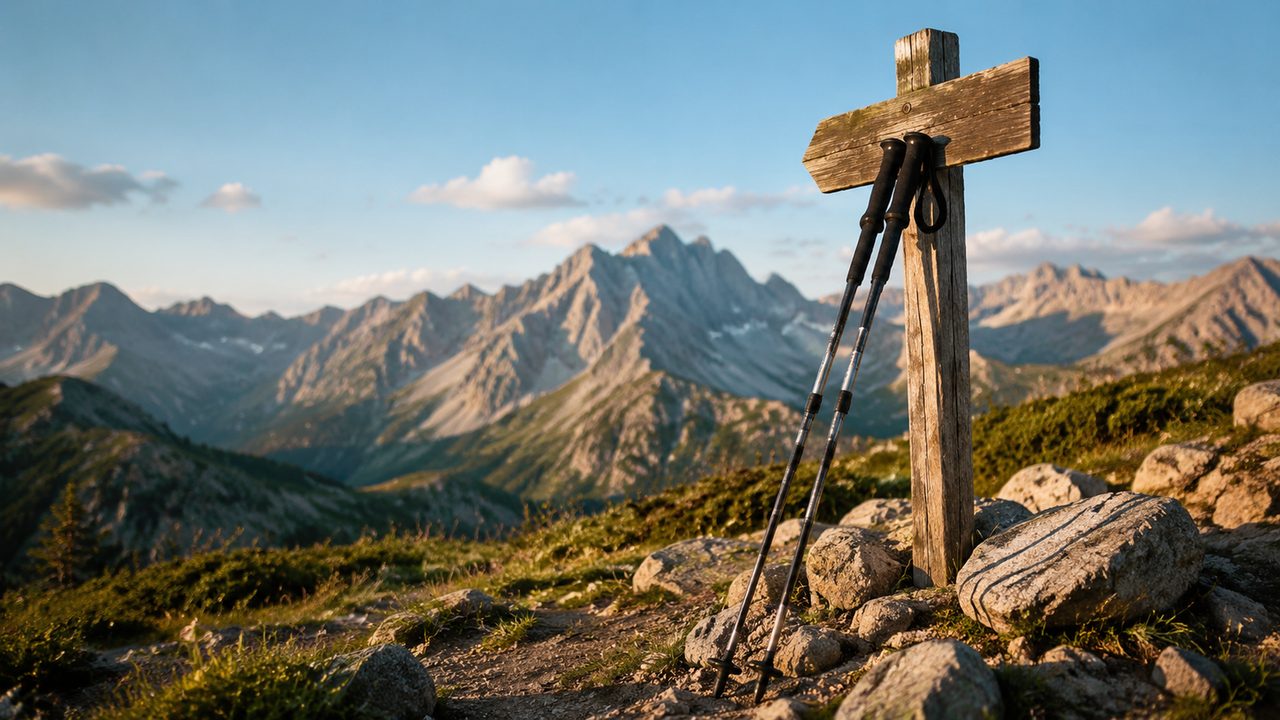
Ask ten hikers about trekking poles and half will swear by them, half will call them crutches for the unfit. The truth is that poles are a tool with a specific job: they reduce load on the knees, add stability on rough ground and give you a third leg at crossings. Used well they are the best value upgrade in walking; used blindly they add weight and clutter. This is the honest case.
What poles actually do
Poles redistribute effort: your arms carry some of the weight that would otherwise land on your knees and ankles, and on descents they cut the impact on every step — studies put the reduction in knee load at 20–25 percent on steep downhills. On the flat they are neutral; on smooth paths they add little. They also set a rhythm, which matters more than people admit: a steady four-beat pattern keeps the walking efficient on long days. The same rhythm works on climbs, where planting both poles in turn feels like pulling the hill towards you.
Where they earn their keep
The case for poles is made on three grounds. First, descents: any long downhill with a pack, and the knees will tell you. Second, river and bog crossings: a pole planted upstream is a reliable third leg, and it tests the depth ahead. Third, rough terrain: on boulder fields, loose scree and wet roots, two extra contact points turn a cautious shuffle into a normal walk. Add high altitude, where balance suffers and every step costs more, and the case is closed for most people.
Where they are dead weight
On flat, well-graded trails — canal paths, lowland loops, beach walks — poles are exactly as useful as their price suggests: not very. They are also a nuisance on technical scrambles, where they cannot be used and must be stowed. And they are a burden in the hand on windy ridges where you need a hand for the map. The rule we use: poles come on any trip with more than 500 metres of descent a day, or any crossing of an unknown river, and stay home otherwise.
Types: fixed, twist-lock, flick-lock
Three-piece poles are the standard for walkers because they pack into a luggage-friendly length. Twist-locks are lighter and cheaper; flick-locks are heavier but far more reliable and easier to adjust with gloves on. Fixed-length poles are the lightest and cheapest of all and fine if you are sure of your height. Materials matter at the ends: carbide tips grip rock and mud, rubber caps protect paths and floors, and baskets stop the pole sinking into snow or bog. Buy the lightest pole you can afford that still locks reliably — a floppy lock on a steep descent is worse than no pole. If you plan to fly with poles, check the airline: most accept them as checked baggage, and a few countries treat them as sporting equipment rather than weapons.
Setting length and technique
The basic rule: standing with the pole tip on the ground, your elbow should form a right angle. On ascents, shorten the poles by about 5–10 centimetres; on descents, lengthen them — the extra length takes load off the knees. The strap matters: push down through the strap, not the grip, and your hands stay relaxed. Plant the pole opposite to your downhill foot and let it glide, not stab. Twenty minutes of practice turns poles from a fashion item into a tool.
The one-pole compromise
If you cannot decide, take one pole. A single pole, used on the downhill side and at crossings, captures most of the benefit at half the weight and none of the hand-swapping choreography. It also keeps one hand free for the phone, the map or the dog. Plenty of long-distance walkers finish entire ranges with one pole and never miss the second. The poles that matter are the ones that are out of the pack when you need them — which is the real argument for taking them at all.